
The short answer: a KitchenAid refrigerator that will not cool usually has a working compressor but a broken cold-air delivery. Cold is made near the freezer evaporator and moved to the fresh-food side by a fan and a damper. When that evaporator ices up, the fan quits, or the damper sticks, the fridge warms while the freezer stays cold. Start with the condenser, the door seals, and a power cycle, then read any F# E# code before assuming the worst.
How Kitchenaid Cooling Actually Works
Most built-in and side-by-side KitchenAid refrigerators cool from a single sealed system. Refrigerant runs through one evaporator coil, and a fan blows air across that coil and distributes it between the freezer and the fresh-food compartment. A small motorized damper decides how much of that cold air reaches the top of the fridge. Because one cooling source feeds two rooms, a fault in the fan, the damper, or the defrost system shows up as an uneven temperature long before it looks like a total failure.
That is why the classic symptom is a warm fridge with a still-cold freezer. If both sections were warm at the same time, the compressor or the sealed system would be the first suspect. When only the fresh-food side climbs, the cold is being made but not delivered, and the search narrows to airflow and defrost.
Common Causes, from Simple to Serious
Fouled Condenser and Blocked Airflow
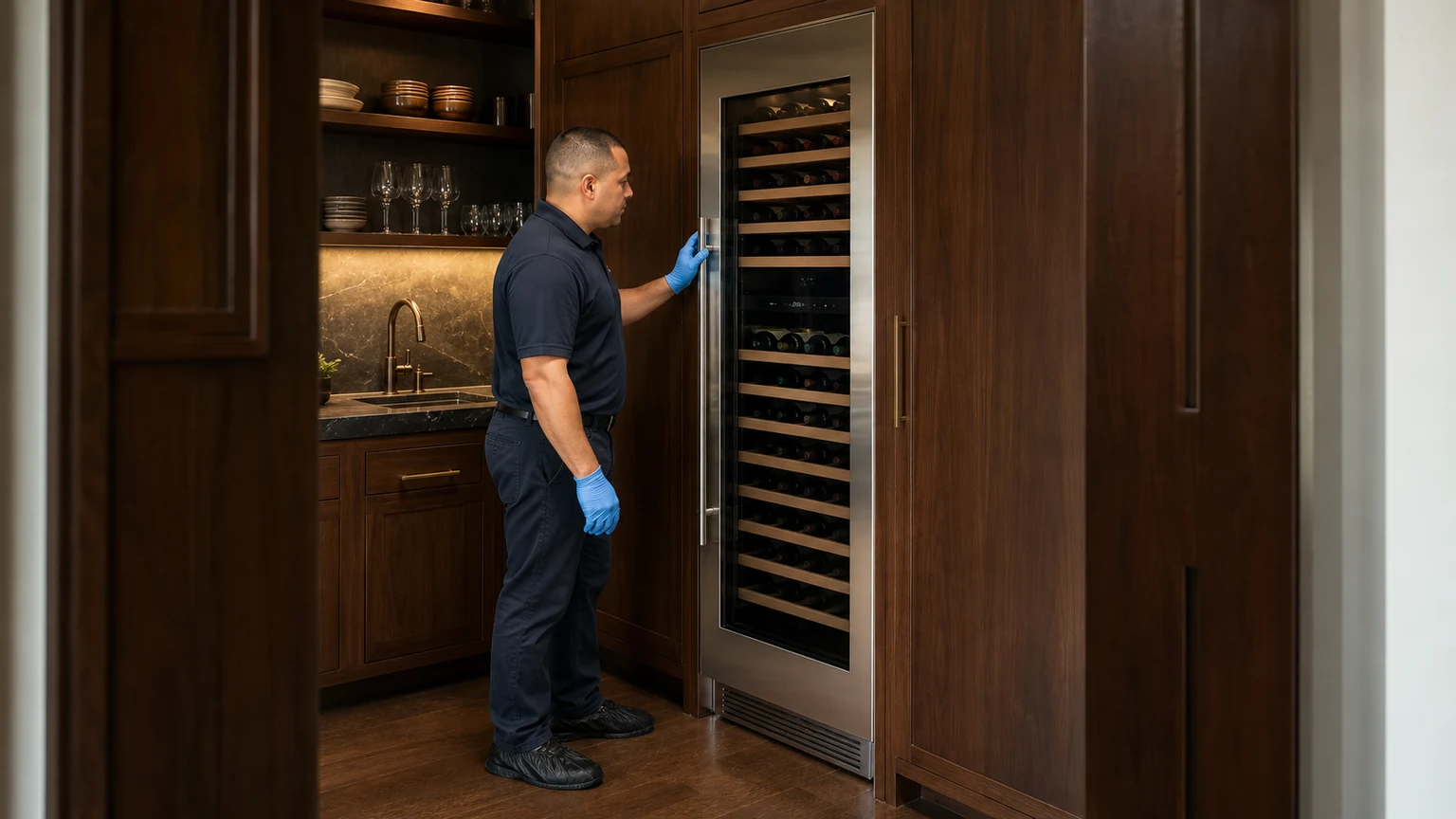
In many Johns Creek kitchens the refrigerator is boxed into custom cabinetry, and the condenser coil collects dust and pet hair over the years. A dirty condenser makes the compressor work harder and cool less. Vacuuming the condenser and confirming the vents are not blocked by grocery boxes is the first thing to rule out, and it costs nothing.
Defrost System Failure
The evaporator naturally builds frost, and a defrost heater melts it on a timed cycle. If the defrost heater, sensor, or control fails, frost keeps building until it blocks the coil and chokes off airflow. The freezer may still read cold while the fridge starves for cold air. This is one of the most common reasons a KitchenAid stops cooling on one side.
Evaporator Fan or Damper Failure
A dead evaporator fan makes cold at the coil but sends none of it upstairs. A stuck damper does the same by refusing to open. Both leave the freezer cold and the fridge warm, and both are frequent, fixable faults.
Kitchenaid F# E# Codes to Check
KitchenAid shares the Whirlpool-family diagnostic system, so its codes appear as an F number paired with an E number. The F points at the system, the E at the specific fault. The table below covers the cooling-related codes owners see most. Exact meanings differ by model, so use these to point the diagnosis, not to condemn a part.
| Code | System | What It Usually Points To |
|---|---|---|
| F1 E1 | Main control | Control board fault or corrupted memory affecting cooling commands |
| F2 E1 | Sensor circuit | Refrigerator or evaporator thermistor out of range, skewing temperature control |
| F3 E1 | Defrost sensor | Defrost thermistor open or shorted, which can leave the evaporator iced over |
| F5 E1 | Damper / fan circuit | Air damper or evaporator fan not responding, cutting cold airflow to the fridge |
| F7 E1 | Communication | Control boards not talking to each other, which can stall the cooling routine |
A code narrows the field but never replaces a hands-on check. A defrost sensor code, for example, tells us where to look, but the real fault might be the heater it protects rather than the sensor itself.
If the fresh-food compartment is climbing above a safe range, do not wait for the repair to move your perishables. A closed refrigerator holds a safe temperature for about four hours, and a full freezer for roughly a day. Shift milk, meat, and leftovers into a cooler with ice or into the still-cold freezer, and keep both doors shut as much as possible. Keeping the doors closed slows the warm-up and protects what is inside while service is scheduled.
What You Can Try Before Booking
A few checks are safe and sometimes solve it. Confirm the temperature is set correctly and was not bumped. Vacuum the condenser and clear anything blocking the interior vents. Inspect the door gaskets for a poor seal that lets warm air in. Then power the unit off at the breaker for several minutes and back on, which can clear a hung control and, on some models, force a defrost. If the fridge is still warm after a few hours, or a frost sheet is visible on the rear freezer panel, the fault is internal and needs a technician.
What a Technician Checks
When the owner steps do not fix it, the diagnosis gets specific. We pull the rear freezer panel to inspect the evaporator for frost, test the defrost heater and sensor for continuity, and confirm the evaporator fan spins and the damper opens on command. We read any stored F# E# code and verify it against the actual circuit. If the sealed system is at fault, we test the compressor and the refrigerant charge. Our built-in refrigeration work covers the whole cooling path, and you can see the scope on our refrigerator repair page. KitchenAid parts are model-specific, so getting the right Genuine OEM Components the first time keeps the repair to a diagnostic.
Frequently Asked Questions
Why Is My Kitchenaid Refrigerator Not Cooling but the Freezer Is Fine?
What Do the F and E Codes Mean on a Kitchenaid Refrigerator?
How Long Can Food Stay Safe If My Kitchenaid Stops Cooling?
Related
Kitchenaid Repair
KitchenAid refrigerators, ranges, ovens, and dishwashers serviced across Johns Creek and Atlanta metro.
View brand → ProblemNot Cooling
How we trace a warm refrigerator from the compressor to the sealed system and back.
Read more → ServiceRefrigerator Repair
Defrost, fan, damper, and sealed-system repairs for built-in and column refrigeration.
View service →